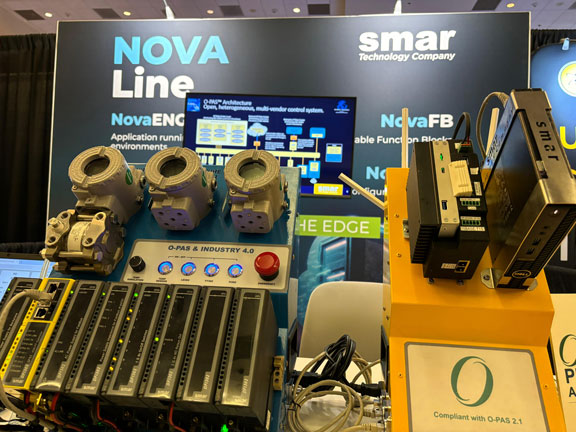







DFI302 is a key-interfacing element in the distributed architecture of field control systems. It combines powerful communication features with direct I/O access and advanced control for discrete and continuous applications. Due to its modular structure, it can be placed inside panels in the control room or sealed boxes in field. Highly expandable, it is targeted to applications ranging from small standalone systems to large and complex plants.
DFI302 is a modular multifunctional device with a DIN-rail mounted backplane into which all components are installed, including main and fieldbus power supplies (DF50 and DF52, respectively), controllers (DF51, DF62, DF63, DF73 and others), and line impedance (DF53) modules. They are plugged-in through industrial grade connectors and by using a robust metal screw. A conventional I/O subsystem with modules for analog and discrete inputs and outputs can be connected (optional). Modularity is the keyword for DFI302 flexibility. Besides, since all modules including the fieldbus power supply subsystem are plugged into the same backplane, the DFI302 comes up as a single integrated unit.
Main Features:
Distributed architecture
The modular concept of the DFI302 makes it the perfect building block of the system topology. Any topology can be created with the DFI302. All system set up and maintenance can be easily done with high efficiency and interoperability. The distribution of the control task among field devices and multiple DFI302 systems increases the overall performance and reliability.
High Reliability
The distributed and embedded architecture of the DFI302 warrants high reliability even if in industrial environments: no HDDs, and no mechanical moving parts. The internal processes (communication, function blocks, supervision, etc.) are controlled by a prioritized multitasking operating system guaranteeing determinism and real-time operation.
Configuration
The DFI302 is completely configurable through FOUNDATION fieldbus function blocks. It allows the whole system (DFI302 and field devices) to be set up by single software.
Supervision
The DFI302 is developed with the most updated technology. The use of leading technologies as OPC (OLE for Process Control) makes the DFI302 the most flexible fieldbus interface in the market.
The OPC server allows the DFI302 to be connected to any supervision package. The only requirement is to have an HMI compatible with OPC. DFI302 connects with most HMI in the market, customizing our System302 to your needs.
System Integration
The advanced communication features found in the DFI302 warrant high system integration.
Redundancy DFI302 supports hot-standby redundancy in several levels:
OLE Server
LAS (Link Active Scheduler)
Ethernet
Function Blocks
H1 Links
Modbus Gateway
Expandable
Each controller can directly access I/O points distributed among local I/O modules. Exploring fieldbus features like interoperability, bridge, and Ethernet, DFI302 system becomes a virtually unbounded solution for industry automation.
For further information about the DFI302 automation platform more quickly, the user manual can be obtained separately by subjects, directly on the site www.smar.com as parts A through L.
They are:
A - Installation and basic configuration
This part has all general and basic information about installation of controllers, racks, I/O modules, IP configuration, OPC servers, firmware update, project types, and general information about adding function blocks and flexible function blocks.
This part also has troubleshooting information, and the SRF (Service Request Form).
It has the following sections:
Overview
Installing
Setting up
Configuring the OPC servers
Configuring strategies
Adding function blocks
Adding logic by using flexible function blocks
Adding I/O modules
Adding racks
Troubleshooting
Appendix (SRF)
You must log in first to download this file.
B - Technical Specifications
This part has all technical specification of the DFI302 hardware components. They are:
This part has information to integrate systems that use Modbus protocol to the DFI302 automation platform. It has the following section:
Adding Modbus
You must log in first to download this file.
D - DF51 Platform
This part has information to create control strategies and redundant systems that use the DF51 controller.
This part also has information about redundant system architecture and its configuration, hot standby redundancy and LAS redundancy. It has the following sections:
This part has information about the DF65 logic coprocessor which is connected to DF51 (controller of DFI302 automation platform) to improve its capacity for discrete control. The ladder logic and the coprocessor function blocks help and improve the Fieldbus control system.
It has the following section:
Adding logic configuration by using coprocessors modules
You must log in first to download this file.
F - Configuring strategies with HSE/FF controllers
This part has information to create control strategies that use the DF62 or DF63 controllers.
It has the following section:
Creating a FOUNDATION fieldbus strategy by using the DF62/DF63
You must log in first to download this file.
G - Configuring strategies with HSE/PROFIBUS controllers
This part has information to create control strategies that use the DF73, DF95 or DF97 controllers.
The DF73 is the HSE/Profibus-DP controller with 2 Ethernet 100 Mbps ports, and 1 Profibus DP channel.
The DF95 is the HSE/Profibus controller with 2 Ethernet 100 Mbps ports, 1 serial port, 2 Profibus PA ports, and 1 Profibus DP channel.
The DF97 is the HSE/Profibus controller with 2 Ethernet 100 Mbps ports, 1 serial port, 4 Profibus PA ports, and 1 Profibus DP channel.
It has the following section:
Creating a Profibus configuration by using DF73, DF95 or DF97
You must log in first to download this file.
H - Configuring strategies with HSE/DeviceNet controllers
This part has information to create control strategies that use the DF79 controller.
The DF79 is the HSE/DeviceNet controller with 2 Ethernet 100 Mbps ports and 1 DeviceNet channel.
It has the following section:
Creating a DeviceNet configuration by using DF79
You must log in first to download this file.
I - Configuring strategies with HSE/AS-i controllers
This part has information to create control strategies that use the DF81 controller. The DF81 is the HSE/AS-i controller with 2 Ethernet 100 Mbps ports, and 2 AS-i channels.
It has the following section:
Creating an AS-i configuration by using DF81
You must log in first to download this file.
J - Redundancy
To meet the requirements for fault tolerance, system availability and safety of the industrial process, the DFI302 HSE controllers (DF62/DF63/DF73/DF75) work with a Hot Standbyredundancy strategy.
This part has information about installation and configuration of redundant systems which use those controllers.
There are many types of input/output modules available for DFI302 automation platform, designed to fit a broad range of applications in the automation and process control industry.
The available types are:
Discrete inputs and outputs
Combined discrete inputs and outputs
Pulse inputs
Analog inputs and outputs
The Digital and Analog Input/Output Modules of DFI302 manual has all information about those modules.
You must log in first to download this file.
L - Interfaces for panels
With the Smar’s panel interfaces is possible to eliminate the hard work of making cables, fixing washers and mounting terminal blocks. Just fit the interfaces in the DIN rail and connect the cable. It’s easy and fast!
The interfaces have many features which will fit your application. They were designed for the Smar’s I/O modules.
The Interfaces for Panels manual has all necessary information. This part of manual can be obtained on the Smar’s website (www.smar.com), downloading the file: